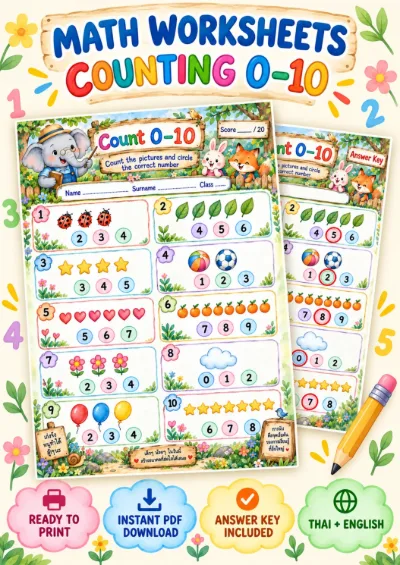
Grades 1–3 (P.1–P.3)
Count 0-10 - Count and Circle
Included with membershipJoin membership

Mathematics
An AR classroom game for Grade 2. Learners can aim with their hands at the camera or play by tapping the screen.
This set has 4 rounds in an interactive sorting activity.
Curriculum indicatorค 1.1 ป.2/4
A look before you play
A few real prompts from the game to help you choose an activity for your class.
Before you play
Decide whether a two-digit subtraction needs borrowing, a step towards subtraction (indicator ค 1.1 ป.2/4), recognise multiples of 5, compare numbers with 70, and tell units of time from units of money.
4 sorting questions with 2 boxes each - 45 - 23 and 68 - 34 need no borrowing; 42 - 17 and 51 - 29 do - 20 and 35 are in the 5 times table; 22 and 38 are not - 45 and 69 are less than 70; 88 and 91 are more - Minute and hour are units of time; baht and satang are units of money
Use just before teaching subtraction with borrowing, so pupils learn to spot which ones need it. About 5-7 minutes; solo mode shows individual understanding. - For the borrowing question, pupils need not work out answers: just compare the ones digits - For the 5 times table, count up in fives together to 40 - 69 versus 70 is a good moment to talk about numbers that are very close - Play it linked to the class to record results in the mark book
- Putting 51 - 29 under "no borrowing" because 5 tens is more than 2 tens. Stress that the ones (1 and 9) decide it - Placing 69 in "more than 70" because the 9 looks big. Compare the tens first - Satang is unfamiliar to some since the coins are rarely used now. Show a 25 or 50 satang coin
Grades 1–3 (P.1–P.3)
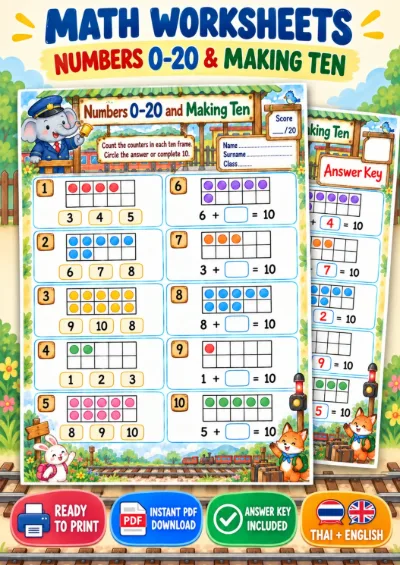
Grades 1–3 (P.1–P.3)
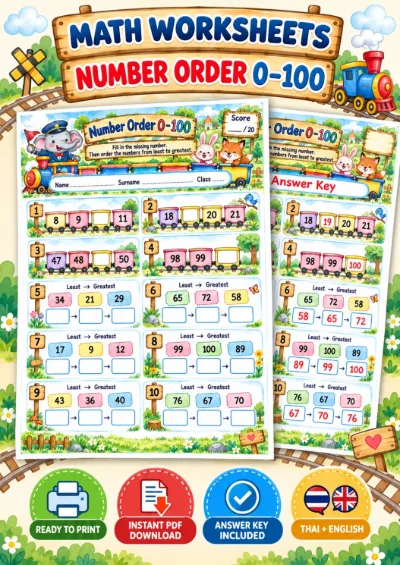
Grades 1–3 (P.1–P.3)
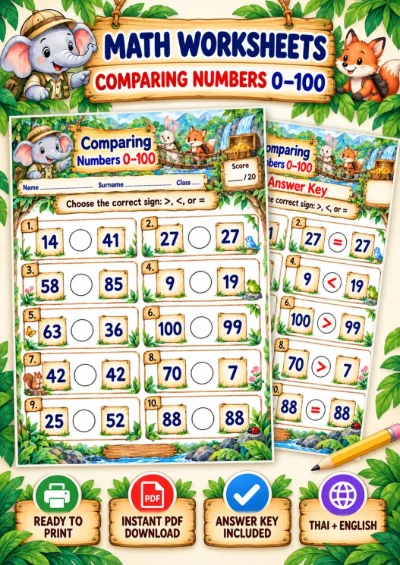
Grades 1–3 (P.1–P.3)
Multiple choiceMathematicsGrade 16 questions
Multiple choiceMathematicsGrade 16 questions
OrderingMathematicsGrade 14 rounds
SortingMathematicsGrade 14 rounds