Grades 1–3 (P.1–P.3)
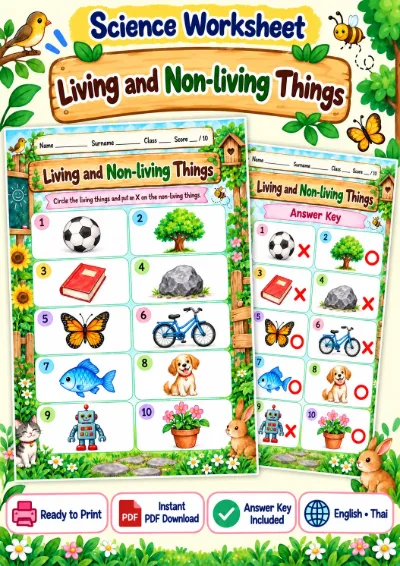
Living and Non-living Things - Circle and Cross
Included with membershipJoin membership

Science
An AR classroom game for Grade 1. Learners can aim with their hands at the camera or play by tapping the screen.
This set has 4 rounds in an interactive sorting activity.
Curriculum indicatorว 1.1 ป.1/1
A look before you play
A few real prompts from the game to help you choose an activity for your class.
Before you play
Sorts everyday things four ways: living or non-living, plant or animal, made by people or natural, water or land animal. Close to ว 1.1 ป.1/1 (naming plants and animals in places) and lays groundwork for ว 1.3 ป.2/1 (living versus non-living).
4 questions, a sorting game with four items each - A tree and a cat are living; a rock and a table are not - An orchid and a mango tree are plants; a bird and a fish are animals - A car and a house are made by people; a mountain and a river occur in nature - Fish and crabs live in water; elephants and tigers on land
Use it at the start of a living-things unit, about 5 minutes in teams, with the teacher reading the items aloud. In question 1, ask simple prompts such as does a table grow? does a cat eat? Afterwards, walk around the school and have each child point out three living and three non-living things. You can link it to a class and record it in the gradebook.
- Question 1: calling the table living because it is made from a tree. Explain that the table no longer grows or eats. - Question 2: putting the orchid with animals because its Thai name (กล้วยไม้) does not sound like a flower. Show a picture of an orchid. - Question 4: hesitating over the crab, having seen crabs walk on the beach. Accept that some crabs come onto land, but here it counts as a water animal.
Grades 1–3 (P.1–P.3)
Grades 1–3 (P.1–P.3)
Grades 1–3 (P.1–P.3)
Grades 1–3 (P.1–P.3)
MatchingScienceGrade 14 rounds
Multiple choiceScienceGrade 16 questions
Multiple choiceScienceGrade 16 questions
SortingScienceGrade 14 rounds