Grades 1–3 (P.1–P.3)
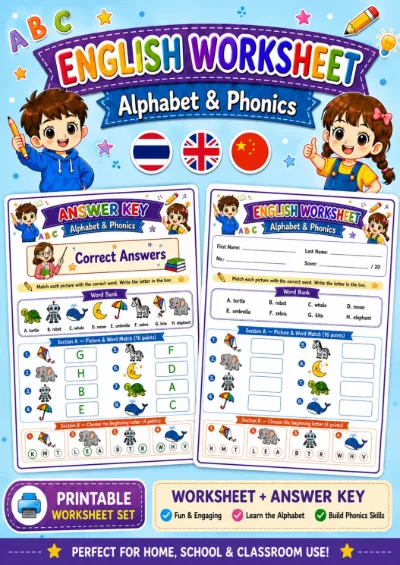
Alphabet & Phonics - Picture and Word Match
Included with membershipJoin membership

English
An AR classroom game for Grade 2. Learners can aim with their hands at the camera or play by tapping the screen.
This set has 4 rounds in an interactive sorting activity.
Curriculum indicatorต 1.1 ป.2/2
A look before you play
A few real prompts from the game to help you choose an activity for your class.
Before you play
Sort everyday verbs and words by time, movement and place (wake up vs sleep, run vs read) and by what people can and cannot do (indicator ต 1.1 ป.2/2).
4 questions, sorting into 2 groups - wake up, brush teeth in the morning; sleep, dream at night - run, jump need moving; read, write are done sitting still - classroom, playground at school; kitchen, bedroom at home - A person can walk, sing; cannot fly, breathe under water
A good movement break mid-lesson, about 5 minutes. During Q2, the class stands to act run and jump, then sits to act read and write. - After Q4, ask Can you sing? and have them answer Yes, I can. - Q3 sorts places, not verbs; tell children before they play - Play it linked to your class so scores go into the gradebook
- dream (Q1) is new; children may put it with morning. Teach it as ฝัน - breathe under water (Q4) is hard to read; weaker readers guess, so read it aloud first - brush teeth (Q1): some drag it to night, as they brush before bed too. Both are true
Grades 1–3 (P.1–P.3)
Grades 1–3 (P.1–P.3)
Grades 1–3 (P.1–P.3)
Grades 1–3 (P.1–P.3)
MatchingEnglishGrade 14 rounds
Multiple choiceEnglishGrade 16 questions
SortingEnglishGrade 14 rounds
OrderingEnglishGrade 14 rounds