Grades 4–6 (P.4–P.6)
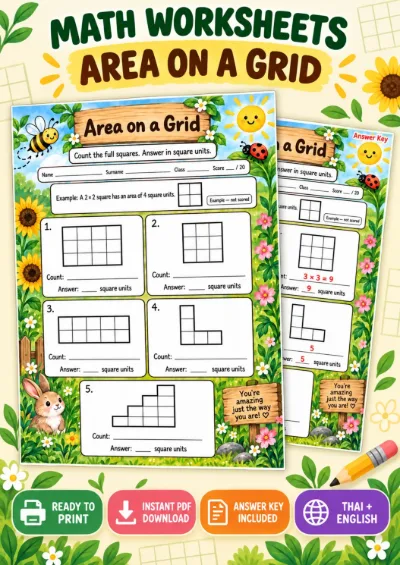
Area on a Grid - Count the Squares
Included with membershipJoin membership

Mathematics
An AR classroom game for Grade 5. Learners can aim with their hands at the camera or play by tapping the screen.
This set has 6 questions in an interactive multiple choice activity.
Curriculum indicatorค 1.1 ป.5/1
A look before you play
A few real prompts from the game to help you choose an activity for your class.
Before you play
Write the prime factorisations of 12, 18 and 20, spot a prime number, and find the HCF and LCM of two numbers, the groundwork for ค 1.1 ป.6/4-5.
6 questions, multiple choice with 3 options - Prime factorisation of 12 (2 × 2 × 3) - Prime factorisation of 18 (2 × 3 × 3) - HCF of 12 and 18 (6) - LCM of 6 and 8 (24) - Which is prime: 27, 29 or 33 (29)
Use after teaching factor trees; about 6 minutes. - Play solo, then put Q3 and Q4 on screen and explain by listing factors and multiples side by side - For Q1, Q2 and Q6, point out that options containing 1 are not prime factorisations, since 1 is not prime - If many miss Q4, count in 8s (8, 16, 24) and see which is also in the 6 times table - Play it linked to the class to record results in the mark book.
- Q4: children often pick 48 (6 × 8), thinking the LCM is the product - Q3: HCF and LCM get mixed up, or children stop at the first common factor, 3 - Q1: 1 × 2 × 6 looks right because it makes 12, but 6 is not prime - Q5: 27 may be chosen for being odd; check with 3 × 9
Grades 4–6 (P.4–P.6)
Grades 4–6 (P.4–P.6)
Grades 4–6 (P.4–P.6)
Multiple choiceMathematicsGrade 16 questions
Multiple choiceMathematicsGrade 16 questions
OrderingMathematicsGrade 14 rounds
SortingMathematicsGrade 14 rounds