Grades 1–3 (P.1–P.3)
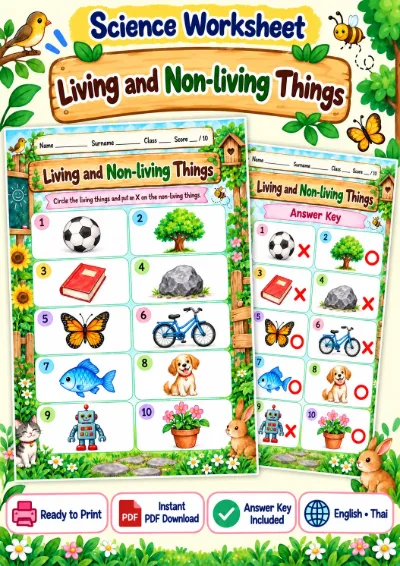
Living and Non-living Things - Circle and Cross
Included with membershipJoin membership

Science
An AR classroom game for Grade 3. Learners can aim with their hands at the camera or play by tapping the screen.
This set has 4 rounds in an interactive matching activity.
Curriculum indicatorว 1.1 ป.5/1
A look before you play
A few real prompts from the game to help you choose an activity for your class.
Before you play
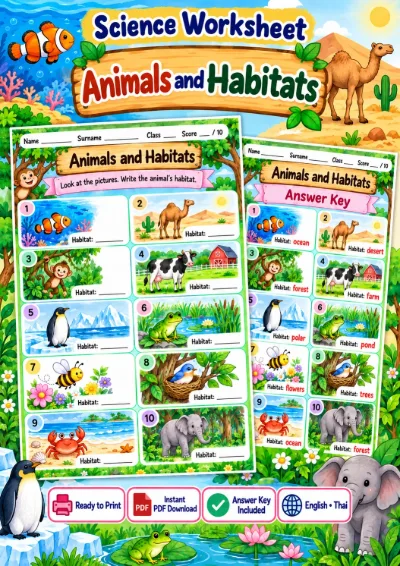
Connects living things' features to where they live: camels, polar bears and cacti adapting, plants and their habitats, camouflage, and bird beaks matched to food. It matches indicator ว 1.1 ป.5/1 (structures and features suited to a habitat as a result of adaptation), Grade 5 content introduced early here.
4 questions, a matching game with four pairs each - Match a polar bear to thick fur and fat, and a cactus to stores water in its stem - Match a mangrove to a mangrove forest and a pine to cold uplands - Match a leaf insect to shaped like a leaf - Match a woodpecker to insects under bark and a duck to filters food from water
Use it after pictures or clips of animals in different habitats, about 6-8 minutes in teams. After question 4, have teams guess what food a chicken's or a sparrow's beak suits. On question 3, point out that a squid squirting ink is escaping rather than camouflaging, so children do not learn it wrongly. A good follow-on is designing an imaginary desert animal. You can link it to a class and record it in the gradebook.
- Question 1: matching the camel to stores water, or believing the hump holds water, a common misconception. Stress that the hump stores fat. - Question 3: swapping zebra and chameleon, not seeing how stripes hide anything. Show a picture of a whole herd where the stripes blur together. - Question 4: swapping hummingbird and woodpecker since both have long beaks. Compare a slender beak that reaches into flowers with a strong one that drills wood. - Question 1 says animals but includes the cactus, a plant; mention this before playing. In question 3, กิ้งก่า is the general word for lizard: the strong colour-changer is the chameleon, while most Thai garden lizards change colour only a little.
Grades 1–3 (P.1–P.3)
Grades 1–3 (P.1–P.3)
Grades 1–3 (P.1–P.3)
Grades 1–3 (P.1–P.3)
SortingScienceGrade 14 rounds
MatchingScienceGrade 14 rounds
Multiple choiceScienceGrade 16 questions
Multiple choiceScienceGrade 16 questions