Grades 1–3 (P.1–P.3)
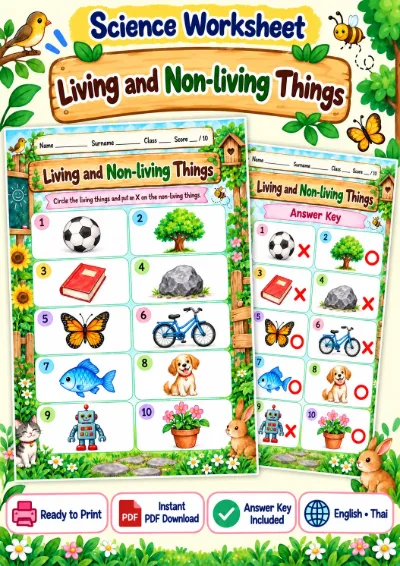
Living and Non-living Things - Circle and Cross
Included with membershipJoin membership

Science
An AR classroom game for Grade 3. Learners can aim with their hands at the camera or play by tapping the screen.
This set has 6 questions in an interactive multiple choice activity.
Curriculum indicatorว 3.1 ป.3/1
A look before you play
A few real prompts from the game to help you choose an activity for your class.
Before you play
Explains Earth and sky: day and night from Earth's spin, a year from its orbit, the Moon orbiting Earth, the Moon's changing shape, and what kind of body the Sun and Earth are. Fits ว 3.1 ป.3/2 (day and night with a model) and links to ป.3/1.
6 questions, multiple choice with three options each - Day and night come from Earth turning on its axis - A year comes from Earth orbiting the Sun - The Moon seems to change shape because the angle of sunlight we see changes (distractor: Earth's shadow covers it) - The Sun is a star; Earth is a planet
Play it after a globe-and-torch demonstration, about 5-6 minutes, solo. Questions 1 and 2 have similar options, so have children stand up and spin once (a day), then walk once around the teacher's desk (a year). For question 4, use a white ball and a torch in a darkened room to show the lit side changing. You can link it to a class and record it in the gradebook. Question 4, on the Moon's phases, is Grade 4 content; treat it as enrichment rather than expecting a full explanation from Grade 3.
- Question 1: choosing the Sun goes round Earth, because they watch it rise and set. Accept that it looks that way, then demonstrate by spinning. - Question 2: answering Earth turning on its axis, mixing it up with question 1. Repeat the spin and the walk around the desk. - Question 4: choosing Earth's shadow covers part of the Moon, a very common misconception. Explain that Earth's shadow causes a lunar eclipse, not the phases.
Grades 1–3 (P.1–P.3)
Grades 1–3 (P.1–P.3)
Grades 1–3 (P.1–P.3)
Grades 1–3 (P.1–P.3)
SortingScienceGrade 14 rounds
MatchingScienceGrade 14 rounds
Multiple choiceScienceGrade 16 questions
Multiple choiceScienceGrade 16 questions