Grades 4–6 (P.4–P.6)
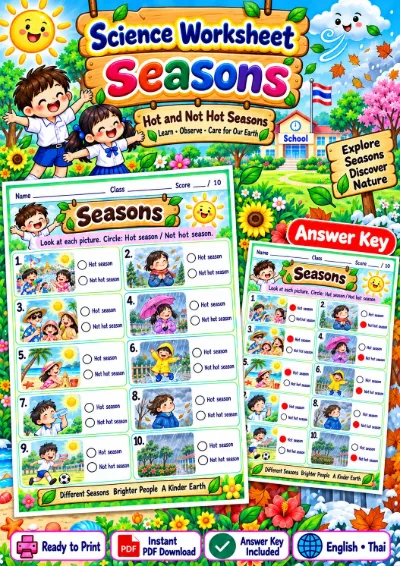
Seasons - Circle the Answer
Included with membershipJoin membership

Science
An AR classroom game for Grade 6. Learners can aim with their hands at the camera or play by tapping the screen.
This set has 4 rounds in an interactive sorting activity.
Curriculum indicatorว 3.2 ป.6/1
A look before you play
A few real prompts from the game to help you choose an activity for your class.
Before you play
Sorts geological events: sudden or slow, igneous or sedimentary rock, water-related or crust-related hazards, and resources that run out or renew. Fits ว 3.2 ป.6/1 (how rocks form) and ว 3.2 ป.6/6 (natural hazards and their effects).
4 questions, a sorting game with four items each - Earthquakes and volcanic eruptions are sudden; rock weathering and coastal erosion are slow - Granite and basalt are igneous; sandstone and shale are sedimentary - Floods and tsunamis are filed as water-related; earthquakes and eruptions as crust-related - Iron ore and natural gas run out; sunlight and hydro power renew
Use it in an Earth and natural-hazards unit, about 6 minutes in teams. On question 3, stop to point out that most tsunamis are caused by undersea earthquakes, so they are both water- and crust-related, then recall the 2004 tsunami on Thailand's Andaman coast. After question 1, ask which provinces suffer coastal erosion. You can link it to a class and record it in the gradebook.
- Question 3: putting the tsunami with crust-related, knowing tsunamis come from earthquakes, which is correct reasoning. The item really is ambiguous; if a child gives this reason, count their understanding as correct even though the game keys it as water-related. - Question 2: calling basalt sedimentary because the name is unfamiliar. Explain that basalt forms from cooled lava. - Question 4: calling iron ore renewable because steel can be recycled. Separate recycling from forming anew in nature.
Grades 4–6 (P.4–P.6)
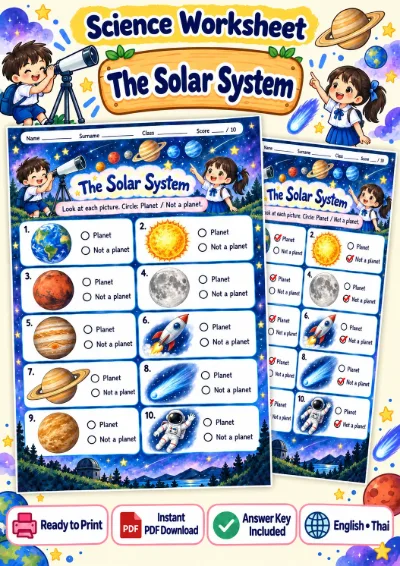
Grades 4–6 (P.4–P.6)
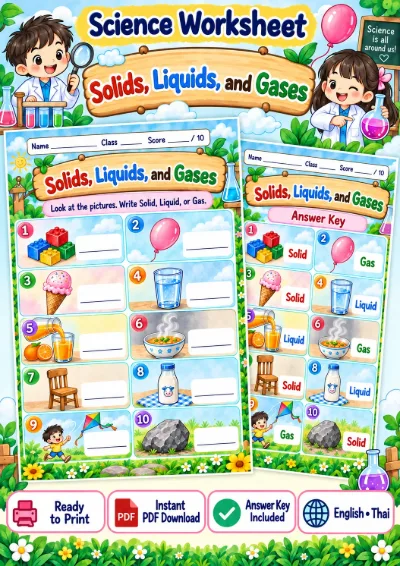
Grades 4–6 (P.4–P.6)
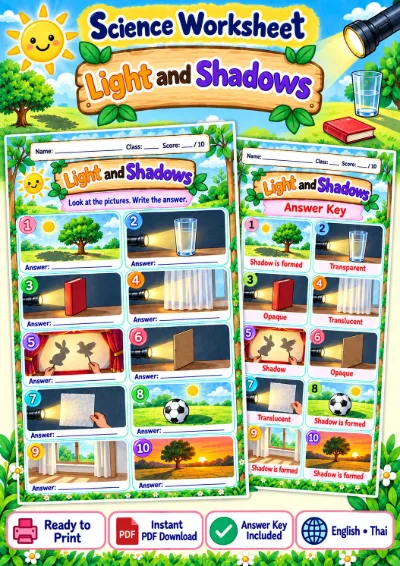
Grades 4–6 (P.4–P.6)
SortingScienceGrade 14 rounds
MatchingScienceGrade 14 rounds
Multiple choiceScienceGrade 16 questions
Multiple choiceScienceGrade 16 questions